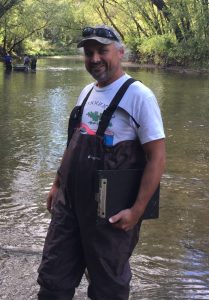
Will Kopp started at the Allamakee SWCD in 2025 as the watershed coordinator for the Yellow River Watershed Project. He graduated in May 2024 from Upper Iowa University with a Bachelor of Science degree in Conservation Management and a minor in Earth Systems. He and his family live in Howard County.
The Yellow River Watershed project has been administered in the past through the Winneshiek County office. In 2025, the project administration moved to the Allamakee County office. Along with this change, our focus area is expanding from the original “Headwaters of the Yellow River” watershed into the Upper Yellow River, an area covering more than 30,000 acres mostly in Allamakee County. This expansion will allow us to reach more producers, support more conservation projects, and continue addressing local water quality concerns identified in the Yellow River Watershed Management Plan.
The Yellow River Headwaters Project is funded through the Iowa Department of Agriculture and Land Stewardship (IDALS) and the Iowa Department of Natural Resources (DNR) with Section 319 and Water Protection Fund support. These programs provide cost-share assistance up to 75% in some cases for conservation practices that improve soil health, reduce erosion, and protect water quality.
Practices eligible for cost-share include water and sediment control basins, which reduce gully erosion and capture field runoff; filter strips, which intercept nutrients and sediment before they reach streams; and grassed waterways, which stabilize areas of concentrated flow and improve field efficiency. Each of these practices supports both environmental protection and long-term agricultural productivity.
For livestock producers, there are also opportunities to implement managed grazing systems and stream corridor improvements. When livestock access to streambanks is managed through rotational grazing, fencing, and off-stream watering systems, both the land and the herd benefit. Streambank vegetation recovers, water quality improves, and well-managed pasture systems tend to produce healthier forage and more resilient grazing conditions.
These conservation efforts are about more than compliance or funding; they reflect a shared responsibility to care for the land that sustains us. Good stewardship ensures that our soil remains productive and our waters stay clear for future generations. It’s a practical investment rooted in the understanding that we are part of something larger than ourselves, and that the health of our land is closely tied to the strength of our communities.
Producers and landowners throughout the Upper Yellow River watershed are encouraged to reach out to Will to learn more about available programs, upcoming field opportunities, and technical support. Working together, we can continue to make measurable improvements in the Yellow River watershed while supporting productive and profitable agriculture across our region.
![If you have interest in virtual fencing or rotational grazing systems, consider attending a field day on July 24, 2026. It will be held at 1352 Hawes Road in Harpers […]](https://allamakeeswcd.org/wp-content/uploads/2026/07/grazing_field_day-36x36.png "Grazing Field Day")
![Will Kopp started at the Allamakee SWCD in 2025 as the watershed coordinator for the Yellow River Watershed Project. He graduated in May 2024 from Upper Iowa University with a […]](https://allamakeeswcd.org/wp-content/uploads/2026/07/Yellow_river-36x36.png "Yellow River Watershed Coordinator")
![I’m Janet Borchardt, the new Pheasants Forever Farm Bill Wildlife Biologist covering Winneshiek, Allamakee, Fayette, and Clayton counties! I graduated from Luther College in 2024, where I studied biology and […]](https://allamakeeswcd.org/wp-content/uploads/2025/12/PF-36x36.png "New Pheasants Forever Biologist")
![The Allamakee Soil and Water Conservation District Commissioners made their selection for this year’s Allamakee Scholarship Fund recipients at their March 2026 meeting. The board awarded 5 scholarships totaling $3,750. […]](https://allamakeeswcd.org/wp-content/uploads/2011/04/scholarship-36x36.png "Allamakee SWCD Scholarship Winners")
![CRP fields undergo status reviews at least 2 times during the contract length. NRCS typically conducts these reviews in year 4 and year 9. The year 4 check is to […]](https://allamakeeswcd.org/wp-content/uploads/2016/10/CRP_photos-36x36.png "CRP status reviews")